KSBM Visits Cane Ridge
Dr. Rob O’Lynn
The nation was still young, only about 25 years old and just in the throes of what would become known as the Second Great Awakening—a movement of religious revival that would spread Christianity throughout the expanding national interior, mostly on horseback. In early August 1801, countless scores of people descended upon Cane Ridge, Kentucky, on a quest to discover spiritual revival. Little is known about how the meeting was planned and rain may have curtailed some of the early numbers. However, those who gathered did so first under a tent, sharing in the Lord’s Supper and hearing revival-themed preaching. By the end of the week, it is said that there were “seven ministers, all preaching at one time,” with some using stumps or wagons as makeshift pulpits. ¹ From this one-week revival, a new “unity movement” would be born, what would eventually become known as the Restoration Movement—a movement that sought to approach the Christian faith through the hermeneutical paradigm of Alexander Campbell: “In matters of faith, unity; in opinion, liberty; in all things charity.” ²
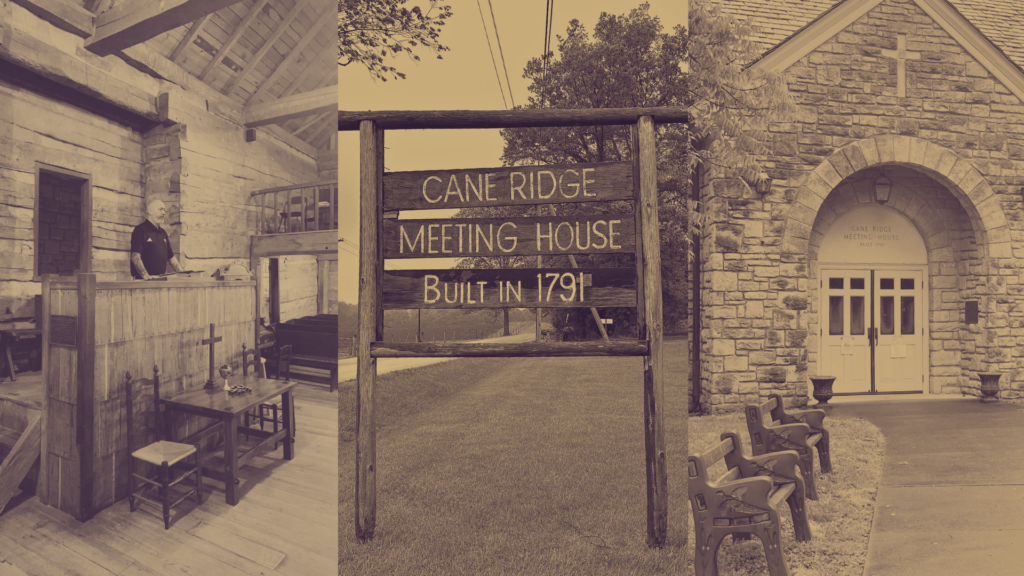
As the spring semester drew to a close, the faculty and students from the Keeran School of Bible and Ministry loaded up on the school bus and made a pilgrimage to that sacred spot and once again walk the grounds and sit in pews that birthed our movement. This was the second time in the last three years that we have taken a day and visited this sacred spot, something that we are exploring how to make a permanent fixture in the curriculum offered to the KSBM students. The Cane Ridge meeting house is one of the oldest houses of worship and the largest one-room wooden building in Kentucky. To preserve the meeting house, a stone structure was built around the original meeting house in the 1930s. Electric lights, modern hymnals and a few other small contemporary liturgical elements are scattered throughout, however the building is essentially as it was in 1801. As I said in my Communion meditation, if these walls could speak, I wonder what stories they would share.
Our visit to Cane Ridge consisted of three elements. First, we gathered for worship in the meeting house. Dr. Rob Shoaff, Dean of the KSBM, welcomed everyone and presented a brief study of the early history of the Restoration Movement and its early theological development based on some research conducted by Dr. Myron Williams, our long-time ministry faculty colleague in the Graduate Bible program. Next, we were treated to a special presentation about the specific history of the original revival from Barton W. Stone himself (portrayed by Dr. Rick Cherok, who teaches our Restoration History course). Then, we engaged in worship, with Sarah James, Cole Corey and Andrew Parker, all freshmen Bible and Worship majors who are also part of our Worship Collective, leading songs that were popular during the late eighteenth and early nineteenth century. The songs were selected and arranged by Kara Hardin, Assistant Professor of Worship and Music. Sermons offered by Cooper Rolph, a senior Youth Ministry student, and Noah Fizer, a junior Preaching student, followed. Our worship time ended with Communion, where I offered the meditation. Following our time of worship, we perused the décor available in the stone structure and visited the museum before ending our time with lunch provided by Brad Green and his Pioneer team.
And while all of this is well and good, the purpose of this article is more than an itinerary report. When Dr. Shoaff and I began to plan this visit to Cane Ridge, it was decided that every presentation would focus on theme of “unity.” As I noted in my meditation, unity is a wonderful attribute, one that inspires participation and adherence. However, like much of the Christian tradition, unfortunately, the Restoration Movement has, at times, been more known for its disunity than its unity. We like to fight so much that we would publish our fights and even have a category of homiletical history called the “Debate Tradition” that is exclusive to our movement. ³ And, yet, there is that mantra: “In matters of faith, unity; in opinion, liberty; in all things charity.” Cooper addressed this in his sermon from Ephesians 2:11-22 by noting all the “silly things we as Christians allow to break up our unity and fellowship,” also noting that it is not much different outside the church. Yet, we should strive for unity in Christ. To do so, Cooper challenged, we need “to start seeing people how Jesus sees them, and “do this…wholeheartedly” because a unified church “is the most powerful witness we can give to those who are lost.” Noah followed this up by exhorting us to once again take up the attitude of togetherness that is seen in the early Church (Acts 2:42-47), something that I alluded to from the words of Paul that “the same mind be in you that was in Christ Jesus” (Phil. 2:5) so that we again be known as a people who begin with unity, move to liberty and always end with charity.
1 D. Newell Williams, “Cane Ridge Revival,” in The Encyclopedia of the Stone-Campbell
Movement, ed. Douglas A. Foster, Paul M. Blowers, Anthony L. Dunnavant and D. Newell
Williams (Eerdmans, 2004), 165.
2 Joseph King, “A Memorial Sermon on the Occasion of the Death of Alexander
Campbell,” Millennial Harbinger 37 (May 1866): 203.
3 Michael W. Casey, Saddlebags, City Streets and Cyberspace: A History of Preaching in
the Churches of Christ (ACU Press, 1995), 47-55.